

Most AI acceptable use policy templates that circulate online still look like routine HR paperwork — a short list of permitted tools, a caution about confidential data, and a signature block. They almost never spell out the precise legal duty that actually requires the document, or the moment when ordinary “acceptable use of AI” crosses into high-risk system compliance. Both distinctions now matter in practice for any organisation operating inside the EU.
Why the Policy Document Itself Is Now Evidence
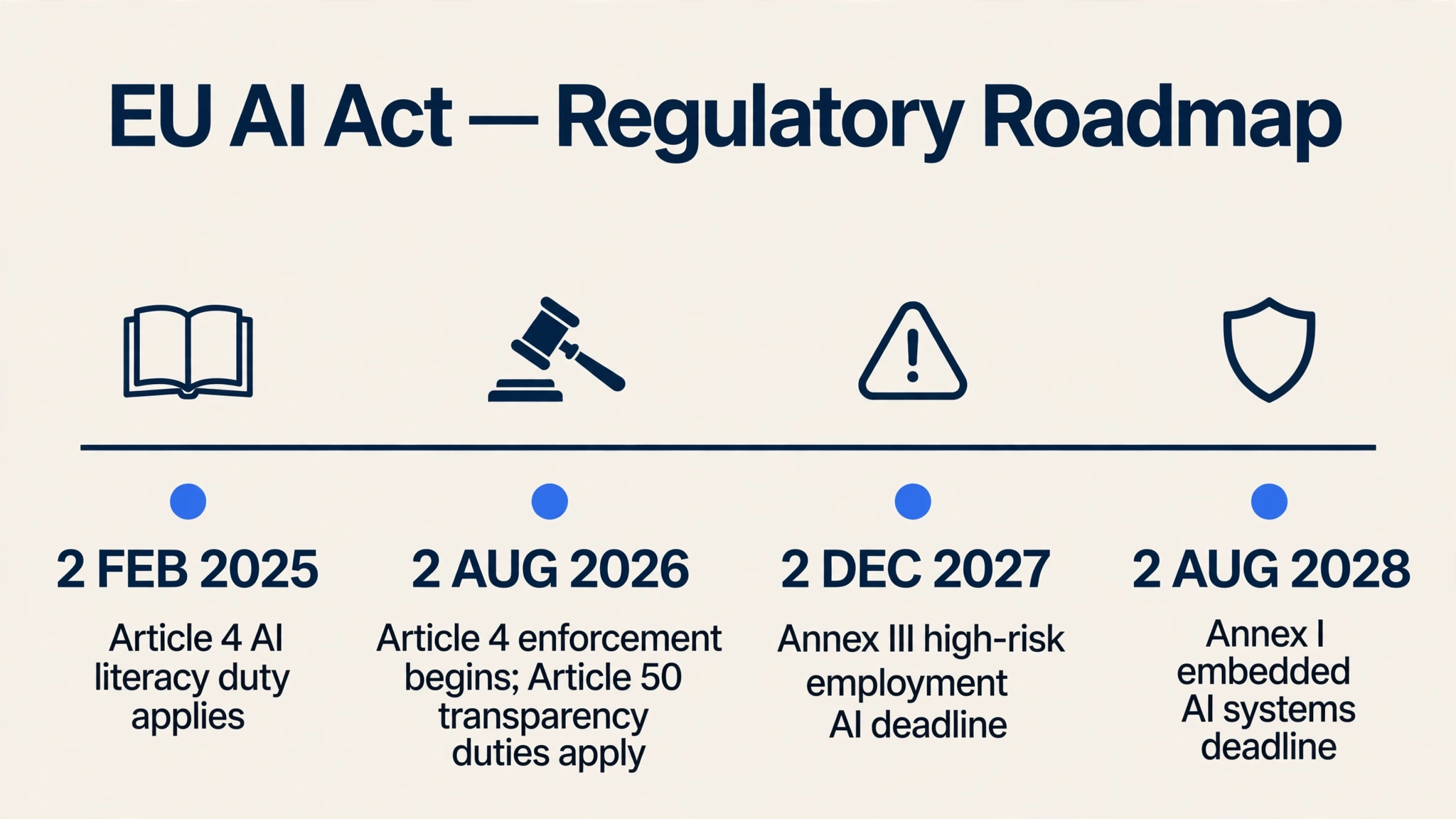
Article 4 of Regulation (EU) 2024/1689 obliges providers and deployers of AI systems to put measures in place that secure, to the best of their ability, an adequate level of AI literacy among staff and others who operate those systems on their behalf. The measures must be scaled to the technical knowledge, role and context of the people involved. This duty has been in force since 2 February 2025. National market surveillance authorities acquired formal supervisory and enforcement powers over it from 2 August 2026, following the staged timetable set out on the European Commission’s AI Act Service Desk page for Article 4.
The Digital Omnibus on AI — Regulation (EU) 2026/1744 — took effect on 27 July 2026 and softened the language of Article 4 from “ensuring a sufficient level of literacy” to “supporting its development.” Neither the original applicability date nor the August 2026 enforcement start was altered by that change, as confirmed in the Official Journal text of Regulation (EU) 2026/1744.
A written policy that has been distributed and acknowledged is one of the few tangible pieces of evidence an organisation can produce when a market surveillance authority asks what steps were taken. Treating the document as a static onboarding PDF misses the opportunity. Version control, an acknowledgment log linked to named employees, and a clear review cycle transform it from a courtesy notice into something closer to a compliance record.
The reasoning above forms one section of a full governance briefing that also covers the Article 4 enforcement gap, the Article 99 and GDPR Article 83 penalty tiers, and a nine-step implementation checklist with named owners.
The Scope Boundary Most Templates Get Wrong
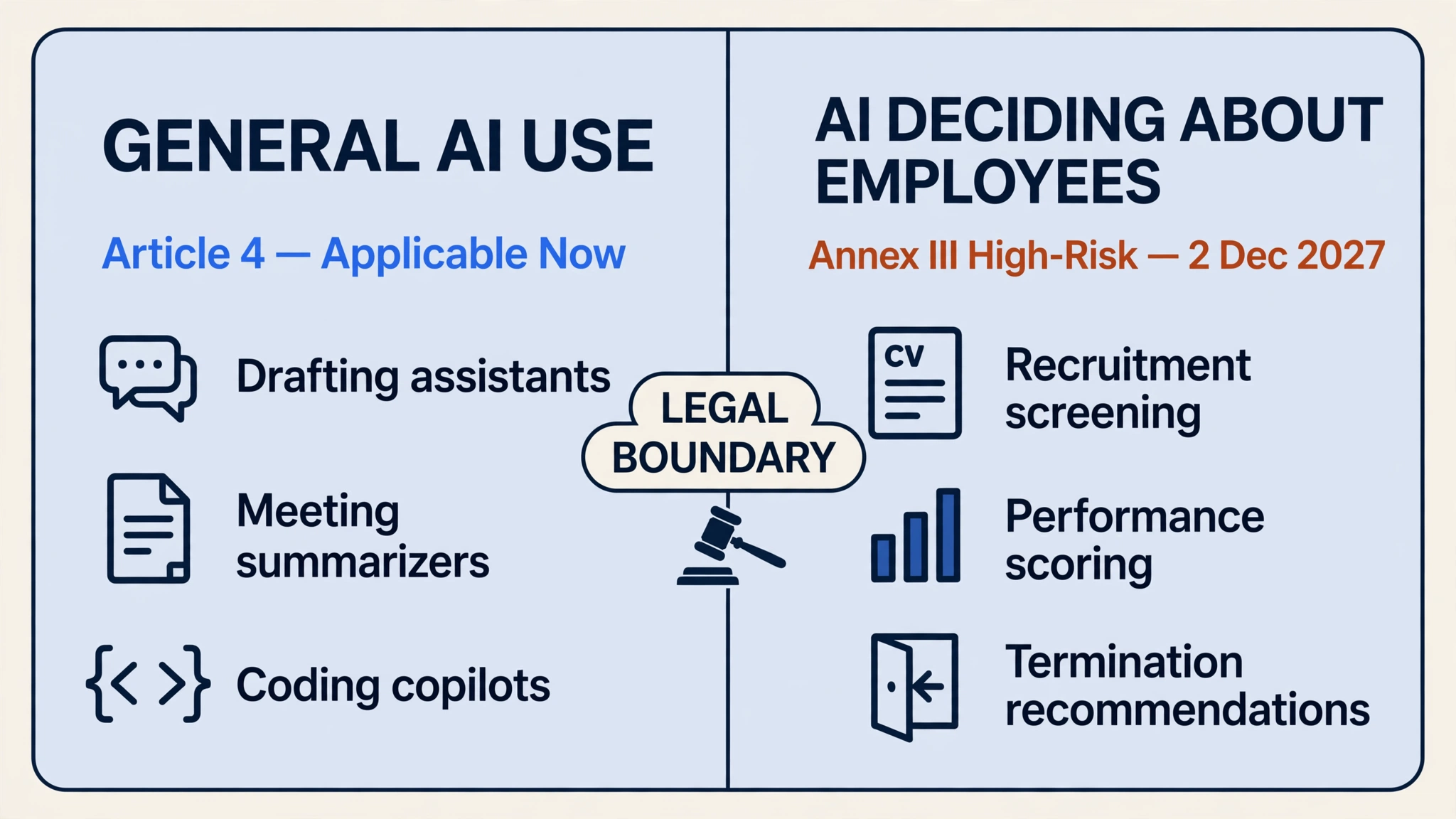
Two distinct obligations are routinely collapsed into a single document. Ordinary employee use of AI tools — chat assistants, drafting copilots, meeting summarisers — falls under the Article 4 literacy duty, which already applies. By contrast, AI systems that make decisions about employees — recruitment screening, task allocation, performance scoring, or recommendations on promotion or termination — come under the high-risk classification in Annex III.
The Digital Omnibus deferred the Annex III obligations for these employment-related systems from 2 August 2026 to 2 December 2027, and for Annex I embedded systems to 2 August 2028, in line with the amended timetable in Regulation (EU) 2026/1744. An acceptable use policy written for staff cannot replace the conformity documentation, human-oversight design or data-protection impact assessment that Annex III will eventually demand of any HR-decision tool. Where an organisation is using AI to score, rank or flag employees rather than simply allowing employees to use AI, that deployment requires its own compliance pathway — not a buried clause inside a general AUP.
Approved AI Tools: Tiering by Legal Exposure, Not Preference
A tool’s tier should be decided by two practical questions: what its account level does with input data, and whether its output triggers a transparency obligation under Article 50. The Article 50 duties for providers and deployers of AI systems became applicable on 2 August 2026. They cover systems that interact directly with people, generate or manipulate synthetic content, or produce material published on matters of public interest, as explained in the European Commission’s guidelines on transparency obligations for providers and deployers of AI systems, issued on 20 July 2026.
One clarification that belongs in the policy itself is that individual employees using an employer-supplied AI tool are not treated as separate deployers under this guidance. The employer organisation carries the Article 50(3) and 50(4) deployer responsibilities. That shifts the “approved tools” section from a simple list of staff rules into a mapping exercise for the policy owner: which tools can generate output that reaches an external audience without disclosure, and who must approve that disclosure before publication.
| Tier | Typical use case | Governing question |
|---|---|---|
| Approved, unrestricted | Internal drafting, brainstorming, code assistance | Does the account tier exclude prompts from model training? |
| Approved, disclosure required | External-facing content, synthetic media, public-interest text | Does Article 50 disclosure apply before publication? |
| Restricted, approval required | Tools processing customer or employee personal data | Has a data protection impact assessment been completed? |
| Prohibited | Unvetted consumer tools with no enterprise data terms | No basis exists to answer the questions above |
Data Classification Rules Employees Can Actually Apply
Input classification only works when the boundaries rest on a legal trigger rather than a vague sensitivity label. Two GDPR points fix the “restricted” and “prohibited” tiers in concrete terms:
- Consent is not a viable legal basis for AI tools that monitor or profile employees, given the inherent power imbalance in an employment relationship. Organisations normally rely on legitimate interest under Article 6(1)(f), backed by a documented three-part test, for this kind of processing.
- Systematic monitoring through an AI tool triggers the need for a Data Protection Impact Assessment under Article 35 GDPR before the tool is authorised for that purpose, not after it has already been rolled out.
Once the policy is framed this way, employees no longer have to judge “sensitivity” in the abstract. They receive a clear rule: personal data linked to monitoring, profiling or evaluation of colleagues may not be entered into an AI tool until the DPIA and legal-basis documentation are in place. Everything else — public information, sanitised internal drafts, general research — sits in the lower tiers.
Human Review Triggers Tied to Legal Effect
Article 22 of the GDPR limits decisions based solely on automated processing that produce legal effects or similarly significant effects on an individual. The European Data Protection Board’s guidance on automated decision-making and profiling explains how that standard operates in practice, including the requirement that any human intervention must be substantive rather than a formal sign-off on an already determined output.
A robust AUP therefore lists the decision types that demand documented human review before an AI-assisted result is acted upon. Pay adjustments drawn from automated monitoring, disciplinary measures, hiring rejections and performance-based terminations fall squarely inside this category. Naming job titles instead of decision types is the weaker formulation — the duty attaches to the nature of the decision and its effect on the person, not to the identity of the decision-maker.
What Breaks the Policy in Practice
Three failure patterns appear repeatedly once a policy moves from the drafting stage into real enforcement:
- Treating the general AUP as adequate cover for an HR-decision AI tool that is in reality an Annex III high-risk system waiting for its obligations to crystallise.
- Having no mechanism to update the approved-tools list when a vendor alters its default data-training terms — the policy cites a tool, not the configuration that made the tool acceptable.
- Leaving policy breaches disconnected from the organisation’s incident-reporting channel, so that the Article 4 literacy record and any internal AI-incident log remain two separate paper trails.
The Template Structure and What Each Clause Evidences
A policy designed to withstand the obligations described above needs the following sections, each performing specific evidentiary work rather than simply occupying space:
- Scope — draws a clear line between general AI tool use and AI systems used to make employment decisions, stating the Annex III boundary explicitly.
- Approved tools and tiers — mapped to data-training terms and Article 50 disclosure exposure, owned by a named role, and reviewed on a procurement-linked cycle rather than once a year.
- Data classification — anchored to the Article 6(1)(f) legitimate-interest test and the Article 35 DPIA trigger, not to generic sensitivity language.
- Human review requirements — listed by decision type and legal effect, with a direct reference to Article 22 GDPR.
- Acknowledgment and version log — the record that converts the document from a distributed PDF into Article 4 evidence.
- Incident reporting link — ties a policy breach to the same channel used for AI-related data incidents.
These six sections are already drafted and ready to issue — pre-written clauses for each of the points above, complete with [Company Name] placeholders and fill-in fields for effective date, policy owner and version.
Why Documentation Discipline Is Becoming the Real Compliance Test
The regulatory timetable has shifted in a way that rewards careful documentation more than speed. Article 4 is already enforceable. Article 50 transparency duties are already live. Annex III obligations for employment-decision AI systems do not apply until December 2027. That window gives organisations time to keep the two tracks properly separate instead of trying to retrofit a general AUP into a high-risk compliance document under last-minute pressure. The organisations that will be best prepared when the 2027 deadline arrives are those whose acceptable use policy already distinguished between “employees using AI” and “AI deciding about employees,” and that kept records showing they understood the difference.

Covering responsible AI, governance frameworks, policy, ethics, and global regulations shaping the future of artificial intelligence.