
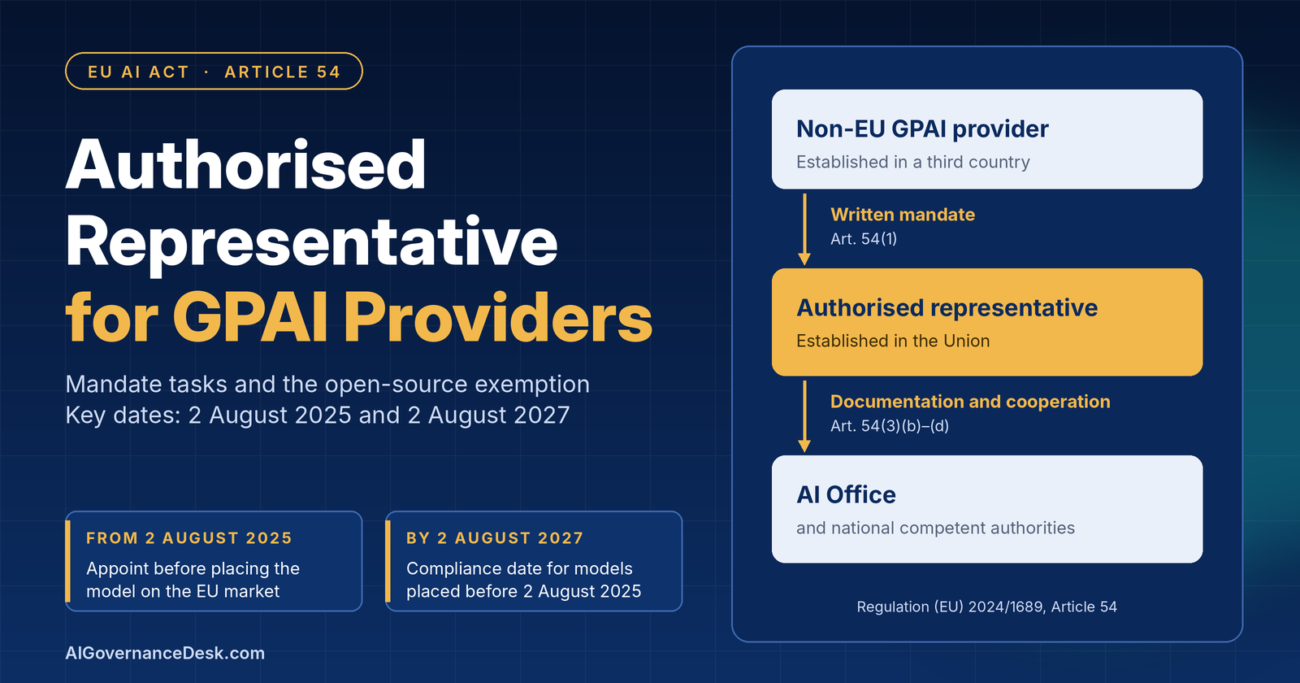
A provider established outside the Union that places a general-purpose AI model on the EU market must first appoint an EU-established authorised representative by written mandate, and Article 54 of the AI Act sets that condition. The Commission’s enforcement powers over GPAI providers have applied since 2 August 2026, and providers of models placed on the market before 2 August 2025 have until 2 August 2027 to take the steps needed to comply. The mandate is therefore a documentation instrument: its wording determines what the AI Office can obtain, from whom, and on what record.
The Trigger in Article 54(1): Third-Country Establishment and Placement
The Commission’s AI Act Service Desk reproduces the consolidated text of Article 54, which opens with one condition. Prior to placing a general-purpose AI model on the Union market, providers established in third countries shall, by written mandate, appoint an authorised representative established in the Union. Three features of that sentence carry the analysis. The duty attaches to establishment in a third country, the timing runs to the moment before placement, and the instrument is a written mandate. Read against paragraph 3, a general EU presence with no mandate covering the listed tasks does not match the wording; that reading is editorial analysis.
Article 54(2) places a separate duty on the provider: it must enable the representative to perform the tasks specified in the mandate. The Service Desk text flags passages added or amended by Regulation (EU) 2026/1744, the Digital Omnibus on AI, which entered into force on 27 July 2026. It flags none in Article 54.
Chapter V, which contains Articles 51 to 56, applies from 2 August 2025 under Article 113(b), with Article 101 excepted. The Commission’s guidelines page for GPAI providers describes the sequence. Provider obligations entered into application on 2 August 2025, and the Commission’s enforcement powers, including fines, entered into application on 2 August 2026. Providers of models placed on the market before 2 August 2025 must comply by 2 August 2027. The Commission describes the guidelines as not legally binding, reflecting its interpretation and guiding enforcement.
Provider status determines who falls under Article 54 at all. According to the same Commission page, only those making significant modifications to a model need to comply with the obligations for GPAI providers, and those making minor changes do not. A non-EU party whose modification reaches that threshold therefore takes on the provider obligations, which include the appointment duty in Article 54(1). That consequence is analysis built on the guidelines page and the Article 54 text.
Two Dates in 2027 and the Question Each One Answers
The first 2027 date, 2 August 2027, comes from Article 111(3), which gives providers of models placed on the market before 2 August 2025 until then to take the necessary steps to comply with the obligations laid down in the Regulation. The second, 2 December 2027, is the application date for Annex III high-risk obligations after Regulation (EU) 2026/1744. It belongs to a different instrument: Article 22 sets a separate representative requirement for providers of high-risk AI systems, and it does not replace the Article 54 mandate.
| Date | Provision | Effect | Relevance to the Article 54 mandate |
|---|---|---|---|
| 2 August 2025 | Article 113(b), Chapter V | GPAI provider obligations, including Articles 53 and 54, apply to models placed on the market from this date | Appointment precedes placement |
| 2 August 2026 | Commission enforcement powers; Article 101 | Information requests, evaluations, measures and fines against GPAI providers become available to the Commission | The representative’s documentation and cooperation tasks become testable |
| 2 August 2027 | Article 111(3) | Providers of models placed before 2 August 2025 take the necessary steps to comply with the obligations laid down in the Regulation | Mandate for legacy models (editorial analysis below) |
| 2 December 2027 | Article 113 as amended by Regulation (EU) 2026/1744 | Annex III high-risk AI system obligations apply | Separate Article 22 representative for high-risk providers |
| 2 August 2028 | Article 113 as amended by Regulation (EU) 2026/1744 | Obligations for high-risk AI systems under Annex I product legislation apply | Same Article 22 workstream, later date |
The dates in the table are listed in the AI Act Service Desk implementation timeline, and the Digital Omnibus left the Article 111(3) date for GPAI models in place.
Article 111(3) does not name the articles it covers, and Article 54 sits in the same Chapter V as the other provider obligations. Read together, a non-EU provider of a legacy model that falls outside the Article 54(6) exemption would treat a compliant written mandate as one of the necessary steps due by 2 August 2027. That is editorial analysis. The Commission page cited above states the 2027 date in general terms for the relevant obligations and does not set it out for Article 54 separately.
A provider that offers both a GPAI model and a high-risk AI system from a third country faces two distinct requirements. Each article specifies its own tasks, so a single combined mandate would need to reproduce both task lists.
Portfolios With Staggered Placement Dates
Article 54(1) attaches to the placing of a model on the Union market, and the 10-year retention period in Article 54(3)(b) runs from the date that model is placed on the market. A provider with several models therefore carries a separate timeline for each one. Models placed from 2 August 2025 need the mandate before placement, while models placed earlier fall under Article 111(3) and its 2 August 2027 date. The mandate and the retention schedule should identify each model and its placement date. That structure is editorial analysis built on the text of Articles 54 and 111(3).
What the Mandate Must Empower the Representative to Do
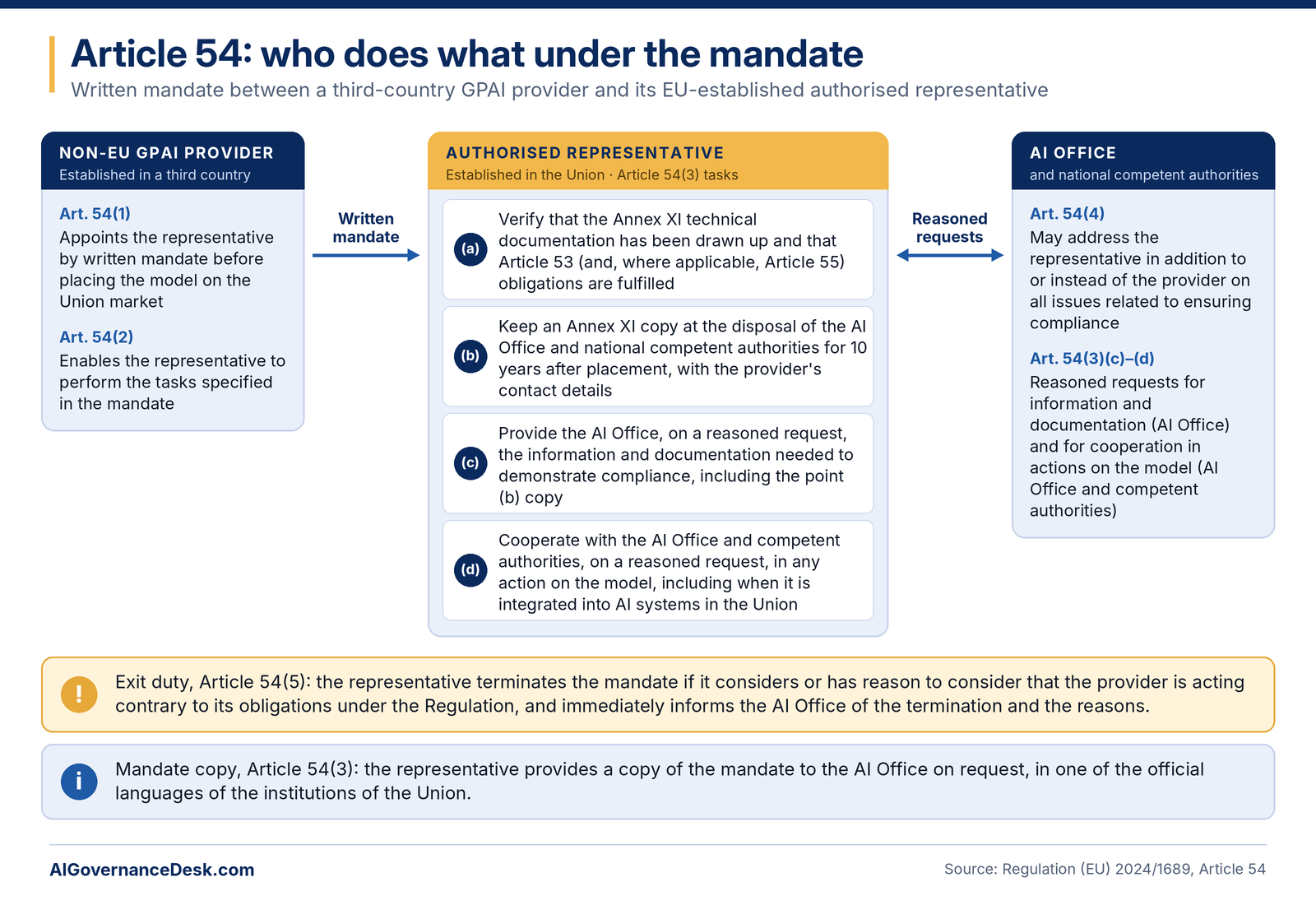
Article 54(3) lists four tasks that the mandate must empower the representative to carry out. The two right-hand columns of the table below are editorial analysis: they pair each task with the record it would plausibly generate and the provider-side duty it checks.
| Article 54(3) task | What the text requires | Evidence the task produces (analysis) | Provider duty it checks |
|---|---|---|---|
| (a) | Verify that the Annex XI technical documentation has been drawn up and that the obligations in Article 53 and, where applicable, Article 55 have been fulfilled | A dated verification record against the Annex XI documentation | Article 53(1)(a); Articles 53 and 55 |
| (b) | Keep a copy of the Annex XI documentation at the disposal of the AI Office and national competent authorities for 10 years after the model is placed on the market, together with the provider’s contact details | A retained copy with a retention schedule and a current provider contact record | Article 53(1)(a) |
| (c) | Provide the AI Office, on a reasoned request, with the information and documentation, including that in point (b), necessary to demonstrate compliance with the obligations in the Chapter | A request-handling channel and a response log | Article 91 requests; Article 53(3) cooperation |
| (d) | Cooperate with the AI Office and competent authorities, on a reasoned request, in any action taken in relation to the model, including when it is integrated into AI systems placed on the market or put into service in the Union | A cooperation protocol that covers integrated AI systems | Article 75 supervision; Article 93 measures |
Enablement, Language and Addressee Clauses
Article 54(3) adds that the representative must provide a copy of the mandate to the AI Office on request, in one of the official languages of the institutions of the Union. A mandate drafted only in the provider’s home language therefore needs a ready translation. Article 54(4) requires the mandate to empower the representative to be addressed, in addition to or instead of the provider, by the AI Office or the competent authorities on all issues related to ensuring compliance with the Regulation. The words “or instead of” matter for drafting: the mandate should state whether the representative may receive and answer requests without prior sign-off from the provider, and Article 54(2) already obliges the provider to enable the representative to act.
The Termination Duty as a Drafting Constraint
Under Article 54(5), the representative shall terminate the mandate if it considers or has reason to consider the provider to be acting contrary to its obligations under the Regulation. It must also immediately inform the AI Office of the termination and the reasons. The provision gives the representative an exit duty that cannot be contracted away, so mandate terms on notice periods, fees on termination and confidentiality need to leave room for the immediate notification to the AI Office. That drafting point is analysis drawn from the text of paragraph 5.
How Articles 91, 93 and 101 Reach the Representative Relationship
Article 91 allows the Commission to request the documentation drawn up under Articles 53 and 55, and any additional information necessary to assess compliance. The request must state its legal basis and purpose, specify the information required, set a deadline, and indicate the Article 101 fines for supplying incorrect, incomplete or misleading information. Article 91 directs the provider, or its representative, to supply the information. Article 54(3)(c) is the mandate-level counterpart, and the two provisions work together only if the representative holds or can obtain the documentation within the deadline set in the request.
Article 93(1) goes further. The Commission may request providers to take appropriate measures to comply with the obligations set out in Articles 53 and 54, to implement mitigation measures where an Article 92 evaluation has given rise to serious and substantiated concern of a systemic risk at Union level, and to restrict the making available on the market, withdraw or recall the model. Article 93(2) allows the AI Office to start a structured dialogue with the provider before a measure is requested.
Article 101 provides for fines of up to 3% of annual total worldwide turnover in the preceding financial year or EUR 15 000 000, whichever is higher, where the Commission finds that the provider intentionally or negligently infringed the relevant provisions of the Regulation. The same paragraph lists failure to answer an Article 91 request or supplying incorrect, incomplete or misleading information, failure to comply with an Article 93 measure, and failure to give access for an Article 92 evaluation. Before a decision, the Commission communicates its preliminary findings and gives the provider an opportunity to be heard, and the Court of Justice has unlimited jurisdiction to review a fining decision.
Article 54 appears by name in Article 93(1)(a), which places a missing or defective mandate within the measures route. Article 101(1)(a) refers to infringement of the relevant provisions of the Regulation, which on a plain reading includes the appointment duty. Whether the Commission applies it in that way is a question for its enforcement practice; the reading here is analysis, not a stated Commission position.
Regulation (EU) 2026/1744 and the Revised Article 75
Regulation (EU) 2026/1744 replaced Article 75. As amended, the article gives the AI Office exclusive competence over AI systems based on a general-purpose AI model where the model and the system are developed by the same provider, or by providers forming part of the same undertaking, subject to listed exceptions. For a vertically integrated non-EU provider, the model-level mandate under Article 54 and system-level supervision by the AI Office therefore run alongside each other. Article 54(3)(d) already extends the representative’s cooperation task to actions relating to the model when it is integrated into AI systems placed on the market or put into service in the Union, so the cooperation protocol in the mandate should cover that integration scenario expressly.
Open-Source Releases and Systemic Risk: Where the Appointment Duty Falls Away
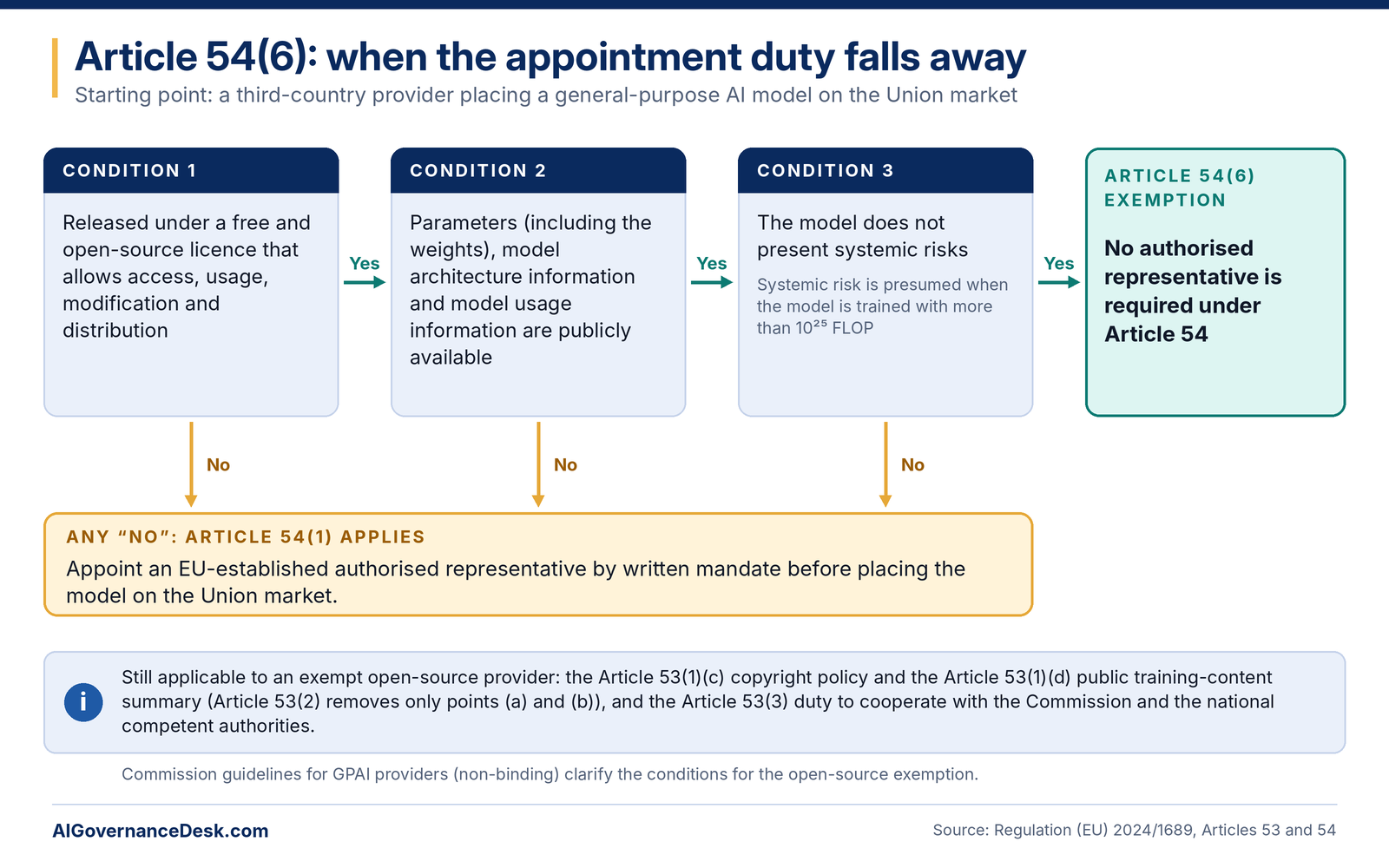
Article 54(6) exempts providers of general-purpose AI models released under a free and open-source licence that allows access, usage, modification and distribution, and whose parameters, including the weights, the information on the model architecture and the information on model usage are made publicly available. The exemption does not apply where the model presents systemic risks. According to the Commission’s GPAI obligations page, models trained with more than 10^25 FLOP are presumed to pose systemic risk, as set out in the AI Act, so the threshold decides whether the exemption survives for a large open-weight model.
The Commission’s guidelines address the licence conditions for the exemption. Freshfields’ analysis of the final guidelines groups the conditions into three areas: the terms of the licence, the absence of monetisation, and public availability of the parameters and architecture. A provider that relies on Article 54(6) is relying on a position that the Commission has interpreted, so the record supporting that position belongs in the compliance file.
The exemption is narrower than it looks across the Chapter. Article 53(2) removes only the obligations in paragraph 1, points (a) and (b), for qualifying open-source models, which are the Annex XI technical documentation and the Annex XII downstream information. The copyright policy and the public training-content summary in points (c) and (d) remain. Article 53(3) also keeps in place a general duty on providers to cooperate as necessary with the Commission and the national competent authorities. A non-EU open-source provider without a representative therefore still answers to the AI Office directly on those points, with no mandate holder in the Union to receive requests.
Appointment Controls Drawn From the Text of Article 54
The following controls derive from the wording of Article 54 and are presented as editorial analysis, not as requirements the Regulation states in this form.
- Mandate scope: the written mandate lists each Article 54(3) task, the addressee clause in paragraph 4, and the termination and notification duty in paragraph 5.
- Documentation access: the representative holds, or can obtain within a request deadline, the Annex XI technical documentation, and the provider’s contact details are kept current.
- Retention: a schedule runs the 10-year period from the date the model is placed on the market, model by model.
- Language: a copy of the mandate exists in an official EU language for production to the AI Office on request.
- Enablement: the provider’s Article 54(2) duty is reflected in access rights, response times and decision authority written into the mandate.
- Exemption record: the open-source and systemic-risk determination behind any reliance on Article 54(6) is documented and dated.
- Submission channel: the mandate states who holds access to the Commission’s submission platform.
The last point follows from the Commission’s guidelines page, which directs providers of general-purpose AI models, or their authorised representatives where applicable, to submit documents through the EU SEND platform. The documents it lists include notifications of models with systemic risk under Articles 51(2) and 52(2), requests for reassessment under Article 52(5), and serious incident reports under Article 55(1)(c). A mandate that is silent on who holds that access leaves a gap between the representative’s tasks and the channel the Commission specifies.
EU-based buyers and downstream providers have a parallel concern. Taylor Wessing’s August 2026 analysis of GPAI obligations recommends that supplier contracts address documentation warranties, copyright and training-data representations, audit and cooperation clauses, and the allocation of authorised-representative duties for non-EU suppliers. Whether a supplier has a functioning mandate in place is a point a vendor-risk review can ask to see evidenced.
Why the Article 54 Mandate Now Works as a Documentation Test for Non-EU GPAI Providers
With the Commission’s powers to request documents, order measures and fine providers in application since 2 August 2026, the mandate is the document a non-EU provider can be asked to produce first. The sequence below follows the dates and provisions set out above.
- For models not yet placed on the market, complete the written mandate before placement, as Article 54(1) provides.
- For models placed before 2 August 2025 and outside the Article 54(6) exemption, treat a compliant mandate as part of the steps due by 2 August 2027 under Article 111(3); this reading is analysis.
- Check the mandate against Article 54(3)(a) to (d), the addressee clause in paragraph 4 and the termination duty in paragraph 5.
- Set the Annex XI retention schedule at 10 years from placement for each model, and keep the provider contact details current.
- Record the open-source and systemic-risk assessment on which any Article 54(6) reliance depends.
- Open a separate Article 22 workstream for any high-risk AI system, with Annex III obligations applying from 2 December 2027 and Annex I obligations from 2 August 2028.

Covering responsible AI, governance frameworks, policy, ethics, and global regulations shaping the future of artificial intelligence.