
Any ranking of the best AI governance platforms for 2027 has to start from the EU AI Act calendar, because the platforms on the market evidence different obligations. Regulation (EU) 2026/1744 moved the Annex III high-risk obligations to 2 December 2027, so a platform selected now has to produce classification records, quality management evidence and transparency records on a defined timetable. Gartner published its first Magic Quadrant for AI Governance Platforms in June 2026 with thirteen vendors; the sections below separate what that placement shows from what each vendor states about EU AI Act coverage.
The EU AI Act Dates That Set the 2027 Buying Sequence
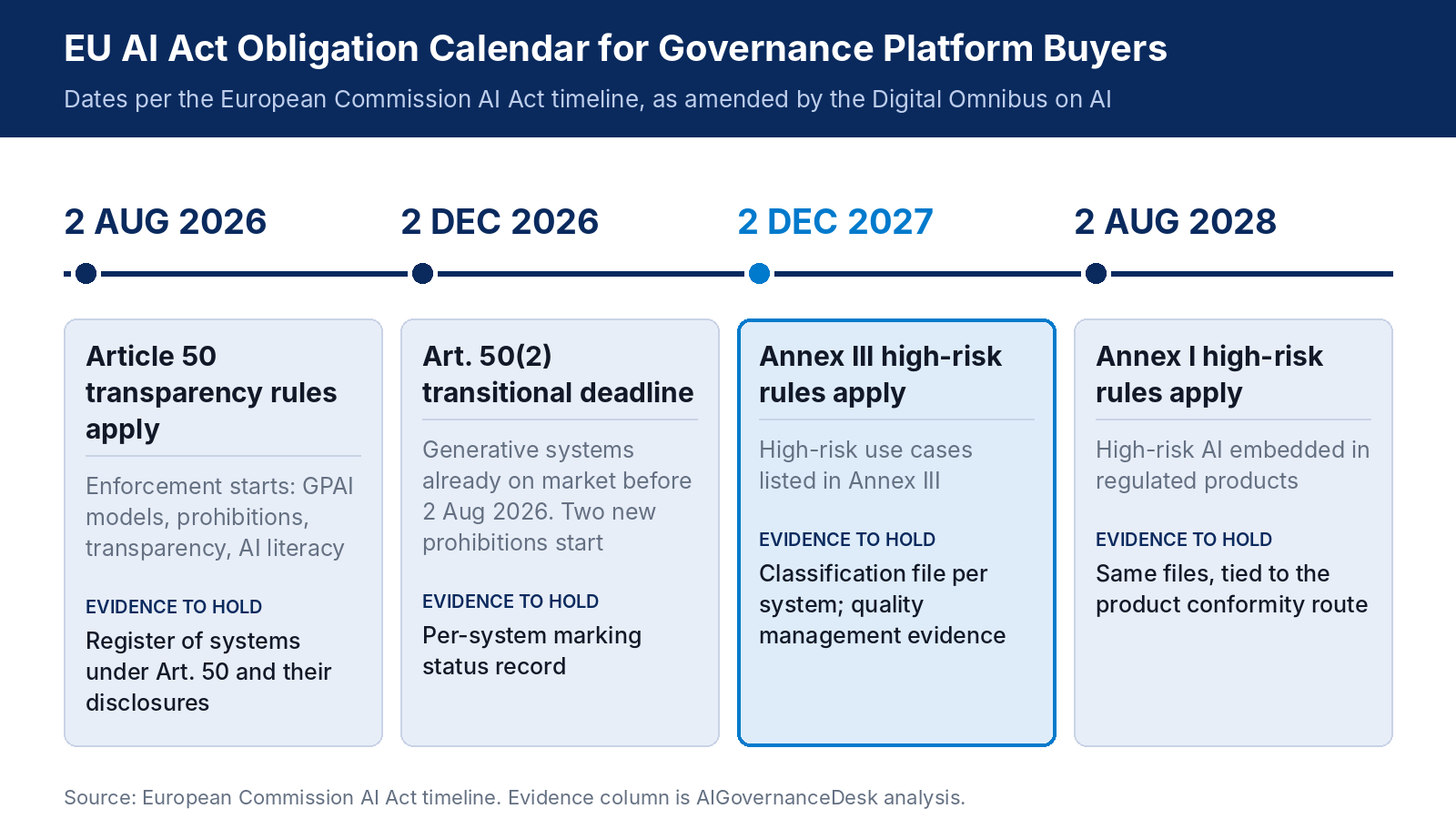
Regulation (EU) 2026/1744, the Digital Omnibus on AI, was adopted on 8 July 2026, published in the Official Journal on 24 July 2026 and entered into force on 27 July 2026 (EUR-Lex record of Regulation (EU) 2026/1744). It amends Regulation (EU) 2024/1689 and defers dates; the Commission’s AI Act Service Desk timeline lists the resulting sequence, and it is the sequence that matters for procurement.
| Date | Provision (Commission timeline) | Evidence a platform would need to hold (analysis) |
|---|---|---|
| 2 August 2026 | Article 50 transparency rules start to apply. Enforcement starts at national and EU level for general-purpose AI models, prohibitions, transparency rules and AI literacy. | A register showing which systems fall under Article 50 and which disclosure each one carries. |
| 2 December 2026 | Transitional deadline under Article 50(2) for certain providers of systems generating synthetic content that were already on the market before 2 August 2026. Two new prohibitions (non-consensual sexual deepfakes and child sexual abuse material) also start. | A per-system record of marking status for generative systems placed on the market before 2 August 2026. |
| 2 December 2027 | Rules for high-risk AI systems in Annex III apply. | A classification file per system and quality management evidence for providers. |
| 2 August 2028 | Rules for high-risk AI embedded in regulated products covered by Annex I apply. | The same files for product-embedded systems, tied to the product conformity route. |
The deferral moved dates and left the obligations in place. Analysis: the sequence puts classification first, since each later obligation attaches to a system that has already been classified, and that ordering should drive which platform capability is tested first.
What the Gartner Magic Quadrant Measures and What It Leaves Open
The Gartner Magic Quadrant for AI Governance Platforms, published on 16 June 2026, profiles thirteen vendors: Airia, Cranium AI, Credo AI, Holistic AI, IBM, ModelOp, Monitaur, OneTrust, Relyance AI, Saidot, SAP, ServiceNow and Truyo. Gartner’s methodology for the quadrant rests on two axes, Ability to Execute and Completeness of Vision. Vendors publish their own placements; OneTrust’s description of the Gartner graphic gives the full spread.
| Quadrant | Vendors, as described in OneTrust’s account of the graphic |
|---|---|
| Leaders | IBM, ServiceNow, Truyo |
| Challengers | Holistic AI |
| Visionaries | OneTrust, ModelOp, Airia, Credo AI, Monitaur |
| Niche Players | SAP, Relyance AI, Cranium AI, Saidot |
Gartner’s own disclaimer, reproduced on Truyo’s Magic Quadrant page, states that Gartner does not advise technology users to select only the vendors with the highest ratings. The companion Critical Capabilities research shows why. Holistic AI reports the highest score in AI Risk and Compliance among thirteen vendors (3.90 out of 5), while Airia reports a first-place ranking for the AI Security use case. A Challenger and a Visionary each lead a use-case ranking, which means quadrant position and use-case fit answer different questions, and neither maps to a specific AI Act article.
The Forrester Wave for AI Governance Solutions was published on 26 August 2025 and evaluated ten providers. It predates both Regulation (EU) 2026/1744 and the first harmonised standard, so its findings cannot speak to either.
Vendor Statements on EU AI Act Coverage, Sorted by What They Actually Say
The table reproduces what each vendor says on its own pages, with the page linked. These are vendor statements, not assessments, and a framework mapping is a description of a control library rather than evidence that using the platform establishes conformity. No platform was tested for this article, and no source here reports hands-on testing, customer references or the quality of exported evidence, so every row is a claim to verify rather than a finding.
| Platform | Gartner placement | What the vendor states |
|---|---|---|
| IBM watsonx.governance | Leader | The IBM product page describes automated policy enforcement, obligation mapping and compliance evidence capture, displays EU AI Act, NIST AI and ISO 42001 framework marks, and lists purchasing options across cloud and on-premises environments. |
| ServiceNow AI Control Tower | Leader | The press release of 5 May 2026 describes five new risk frameworks aligned to NIST and EU AI Act standards as out-of-the-box compliance controls, plus 30 discovery integrations across AWS, Google Cloud, Microsoft Azure and enterprise applications. It gave general availability of the enhancements as expected in August 2026. |
| Truyo | Leader | Truyo’s Gartner page lists the EU AI Act and NIST AI RMF among its compliance solutions, with “+35 more”, and positions the AI governance product beside data privacy, consent and de-identification products. |
| OneTrust AI Governance | Visionary | OneTrust’s navigation lists AI Governance alongside privacy automation, consent and third-party management, and gives the EU AI Act its own regulation solution page. |
| Credo AI | Visionary | A Credo AI platform page states pre-built policy packs for the EU AI Act, NIST AI RMF, ISO 42001 and 20+ standards. Credo AI reports a Leader position in the Forrester Wave of August 2025. |
| Monitaur | Visionary | The Monitaur page states control libraries pre-mapped to the EU AI Act, NIST AI RMF, ISO 42001, NAIC, OCC, SOX, HIPAA and FFIEC, and one inventory across predictive, generative, agentic and third-party AI. |
| Airia | Visionary | Airia states that Gartner highlighted in-line governance through its MCP Gateway, and that continuous monitoring aligns with the EU AI Act, NIST AI RMF and ISO/IEC 42001. |
| Holistic AI | Challenger | Holistic AI reports the top AI Risk and Compliance score in the Critical Capabilities research and a top-three ranking for AI agent governance. |
Five of the thirteen Gartner vendors are not profiled in the table: ModelOp (Visionary), and SAP, Relyance AI, Cranium AI and Saidot (Niche Players). This article did not review their pages, so their absence from the table says nothing about their coverage. A shortlist that includes any of them should start from that vendor’s own EU AI Act material and the written questions later in this article.
Three different jobs sit behind the shared label. Credo AI and Monitaur describe policy and control libraries applied to a system inventory. IBM, ServiceNow, OneTrust and Truyo describe governance extending an existing lifecycle, workflow or privacy platform. Airia describes enforcement at the point where an agent acts. Analysis: a buyer whose first need is Article 50 or classification records is shopping for the first two jobs, while a buyer whose exposure sits in agent behavior at runtime is shopping for the third, and one platform can be strongest at one job and thinner at another.
Classification Records: What the Draft Article 6 Guidelines Ask of an AI Inventory
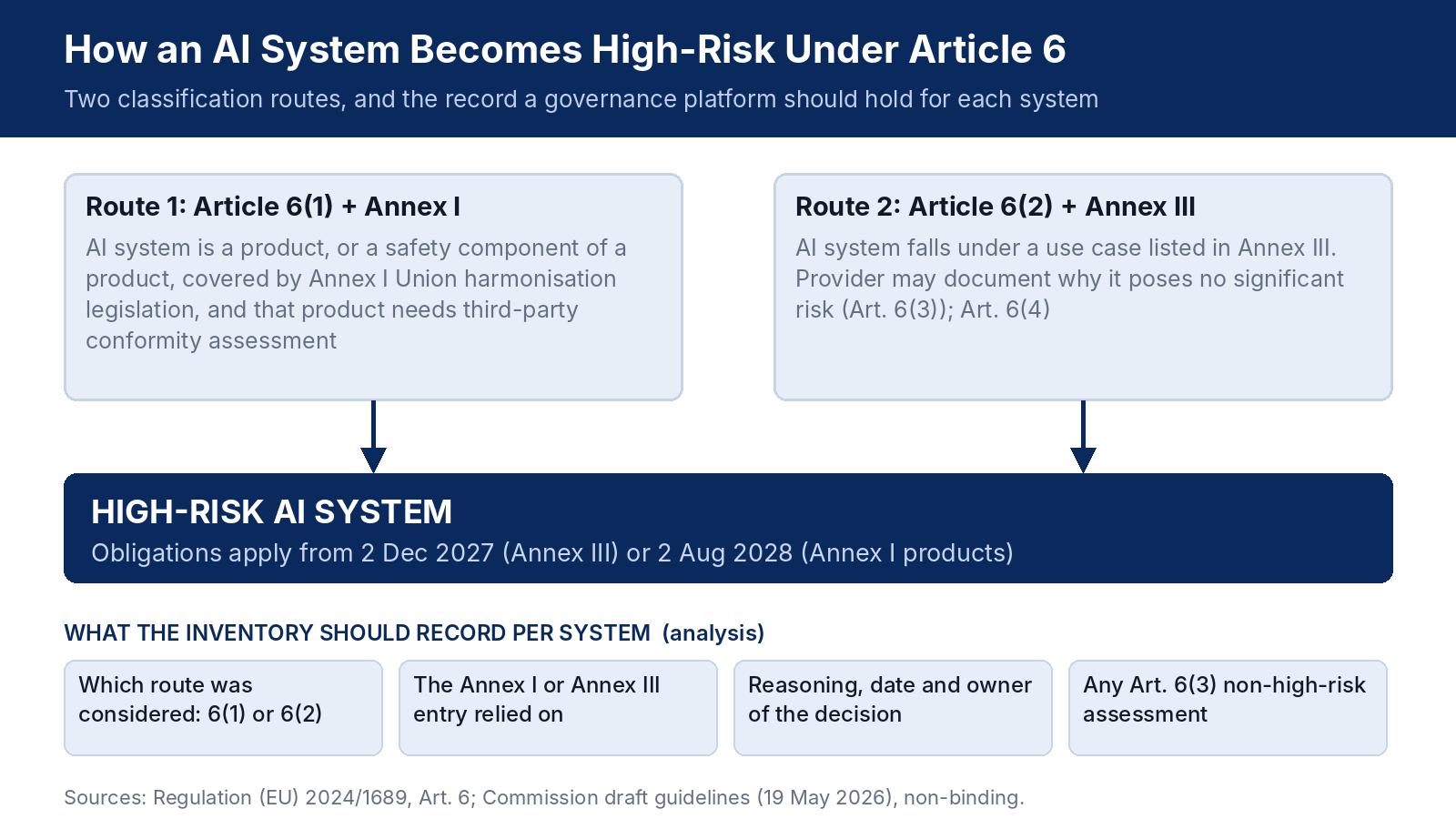
The Commission published its draft guidelines on the classification of high-risk AI systems on 19 May 2026. They follow the structure of Article 6, which provides two routes to high-risk status: Article 6(1), for safety components of products covered by the Annex I harmonisation legislation that require third-party conformity assessment, and Article 6(2), for systems that fall within an Annex III use case. Under Article 6(5) the guidelines carry practical examples of systems that are and are not high-risk. They are a draft, and the sections for each route can be downloaded separately from the Commission page.
Analysis of what that structure means for an inventory feature. A register that holds only a system name and an owner cannot support either route. Three tests separate a classification-ready inventory from a catalogue:
- It records which Article 6 route applies to each system, and keeps the Annex I and Annex III analyses apart.
- It ties each system to the specific Annex III use case that makes it high-risk, or records why none applies.
- It dates the classification rationale and reopens it when the system’s use changes.
Article 17 Evidence After EN 18286: Reading a Vendor’s Framework Claims
Commission Implementing Decision (EU) 2026/2274 of 12 October 2026 published the reference of EN 18286:2026 in the Official Journal and entered into force on 14 October 2026 (EUR-Lex record of the Decision). The Decision states that compliance with a harmonised standard confers a presumption of conformity from the date its reference is published. EN 18286:2026 is the quality management system standard prepared by CEN/CLC/JTC 21 for the Article 17 duty of providers of high-risk systems.
The presumption has limits that a vendor claim has to respect. Modulos’ documentation of the standard, which summarizes its Annex ZA, describes EN 18286 as a voluntary European Standard whose Annex ZA connects it only to Article 17(1) and the first sentence of Article 11(1), and states that using the standard does not by itself ensure every requirement of the Act is met. The same documentation identifies providers of high-risk systems as the primary audience, so a deployer should not read a platform’s EN 18286 mapping as covering its own duties.
ISO/IEC 42001 occupies a different position. The Cloud Security Alliance’s research note of 8 September 2026 states that ISO/IEC 42001 has not been cited in the Official Journal and creates no presumption of conformity under the AI Act. A vendor’s own certificate illustrates the scope question. ServiceNow’s announcement of 18 December 2025 limits the certification, in its footnote, to the AI management system supporting ServiceNow AI, in the role of AI producer and provider. That scope describes the vendor’s own AI, not the systems a customer would register on the platform.
NIST coverage claims carry a version question. The NIST AI RMF roadmap page states that AI RMF 1.0 is being updated and that a revised version is in progress, so a mapping statement is only precise if it names the version.
Questions to put to each shortlisted vendor in writing:
- Does the control library name EN 18286 clauses and the Annex ZA rows, or only the AI Act and ISO/IEC 42001 in general terms?
- Which Article 17(1) points does the platform produce evidence for, and which does it leave to the customer?
- Does any ISO/IEC 42001 certificate cited cover the vendor’s own AI or the customer’s systems?
- Which version of the NIST AI RMF does the mapping use?
Article 50 Transparency: Tests a Platform Should Pass Beyond Classification
Article 50 applies to systems whatever their risk class, so an inventory built only around high-risk classification leaves it uncovered. Under Article 50, providers have to design systems that interact directly with people so that those people know they are dealing with an AI, unless that is obvious to a reasonably well-informed person, and providers of systems generating synthetic audio, image, video or text have to mark outputs in a machine-readable way, subject to the exceptions in the article. Deployers have their own disclosure duties for deepfakes, for AI-generated text published to inform the public on matters of public interest (unless the text has undergone human review or editorial control and a person holds editorial responsibility), and for emotion recognition and biometric categorisation systems. The Commission’s timeline sets the Article 50(2) transitional deadline of 2 December 2026 for certain providers of generative systems already on the market before 2 August 2026.
Analysis of tests a platform should pass:
- It tags each system with the Article 50 duty that applies, separately from its high-risk status.
- It records, for each generative system, whether it was placed on the market before 2 August 2026, since that decides whether the 2 December 2026 transition date applies.
- It records the marking or disclosure method used for each system, and who approved it.
- It reopens the Article 50 and classification records when a system’s use, model or provider changes.
Deployer Duties: What a Platform Has to Evidence When You Do Not Build the System
EN 18286 and Article 17 address providers. An organization that only uses high-risk systems built by others is a deployer, and its duties sit in Article 26. The Commission’s text of the article requires deployers to use a system in accordance with the provider’s instructions for use, assign human oversight to people with the necessary competence, training and authority, and monitor operation on the basis of the instructions. Where the deployer controls input data, that data must be relevant and sufficiently representative for the intended purpose. A deployer must keep the logs the system generates that are under its control for a period appropriate to the intended purpose and for at least six months, inform workers’ representatives and affected workers before a high-risk system is used at work, and inform natural persons that they are subject to the use of certain Annex III systems that make or assist decisions about them.
Analysis: these duties are operational rather than documentary, so the tests for a platform differ from the provider tests above. An organization that is mainly a deployer should ask whether the platform records which person holds oversight for each system, retains the logs it controls for the stated minimum, and triggers the reporting steps Article 26 sets out when a risk or serious incident arises, in the order the article gives them. An organization that is both a provider and a deployer needs both sets of evidence, and a platform that maps to EN 18286 only has covered one of them.
Why Platform Selection Now Follows the Obligation Calendar
The deferral to 2 December 2027 turns 2027 into an implementation year, and the order of work follows the dates in the first table. An organization can sequence a selection this way:
- Complete Article 6 classification for each system against the draft guidelines, since the inventory feature set depends on which routes apply.
- Establish whether the organization is a provider, a deployer or both for each high-risk system, since that decides whether the Article 17 evidence path or the Article 26 operating evidence carries more weight.
- Decide the Article 17 evidence path for provider roles: EN 18286, a combination of EN 18286 with an existing ISO/IEC 42001 system, or a documented alternative.
- Check Article 50(2) marking status for generative systems already on the market against the 2 December 2026 transition date, and record which Article 50 duty applies to each system.
- Set who owns classification decisions and who signs off evidence, using the centralized, federated and hybrid structures compared in the AI governance operating model analysis, because the platform’s approval workflows are configured around that choice.
- Obtain written statements of framework mapping from each shortlisted vendor, using the four questions above.
- Track the final Article 6 guidelines and the NIST AI RMF revision, and record the version each mapping used.

Covering responsible AI, governance frameworks, policy, ethics, and global regulations shaping the future of artificial intelligence.